Chapter 17
Burning Man
The Temporary City
BLACK ROCK CITY, NEVADA, AUGUST 2002
NYC, 2002
Sitting here with Akiko, trying to explain Burning Man, I realize it's impossible.
It's like trying to explain color to someone who's been blind their whole life. Or trying to describe music using only mathematics. The description might be accurate, but it misses the essence.
But I'll try anyway.
Because Burning Man was proof. Proof that everything I'd experienced on the journey, the flow states, the synchronicities, the sense that another world was possible, wasn't just travel euphoria or psychedelic delusion.
It was real.
And thirty-five thousand people were creating it together in the Nevada desert for one week every year.
I went in late August 2002.
The timing was perfect, or maybe it was just another synchronicity. I ran into an old friend from the trance scene.
“You going to Burning Man?” he asked.
Dude, it's like if all the full moon parties in Goa happened in one place for a week. You have to go.
So I went.
Black Rock City.
Population: 35,000.
Lifespan: One week.
Its citizens gather from all over this vibrating sphere to escape the mundane grayness of their regular lives and to begin the crystallization ritual of creative expression and release. This ritual began in 1986 when Larry Harvey and a group of friends celebrated his rebirth after overcoming some personal issues that had been haunting him for a while; they burned a wooden sculpture of a man to symbolize his metamorphosis. Quickly and spontaneously the annual ritual grew to be too big for the beach in San Francisco and was moved to its current location, the Playa, Black Rock City.
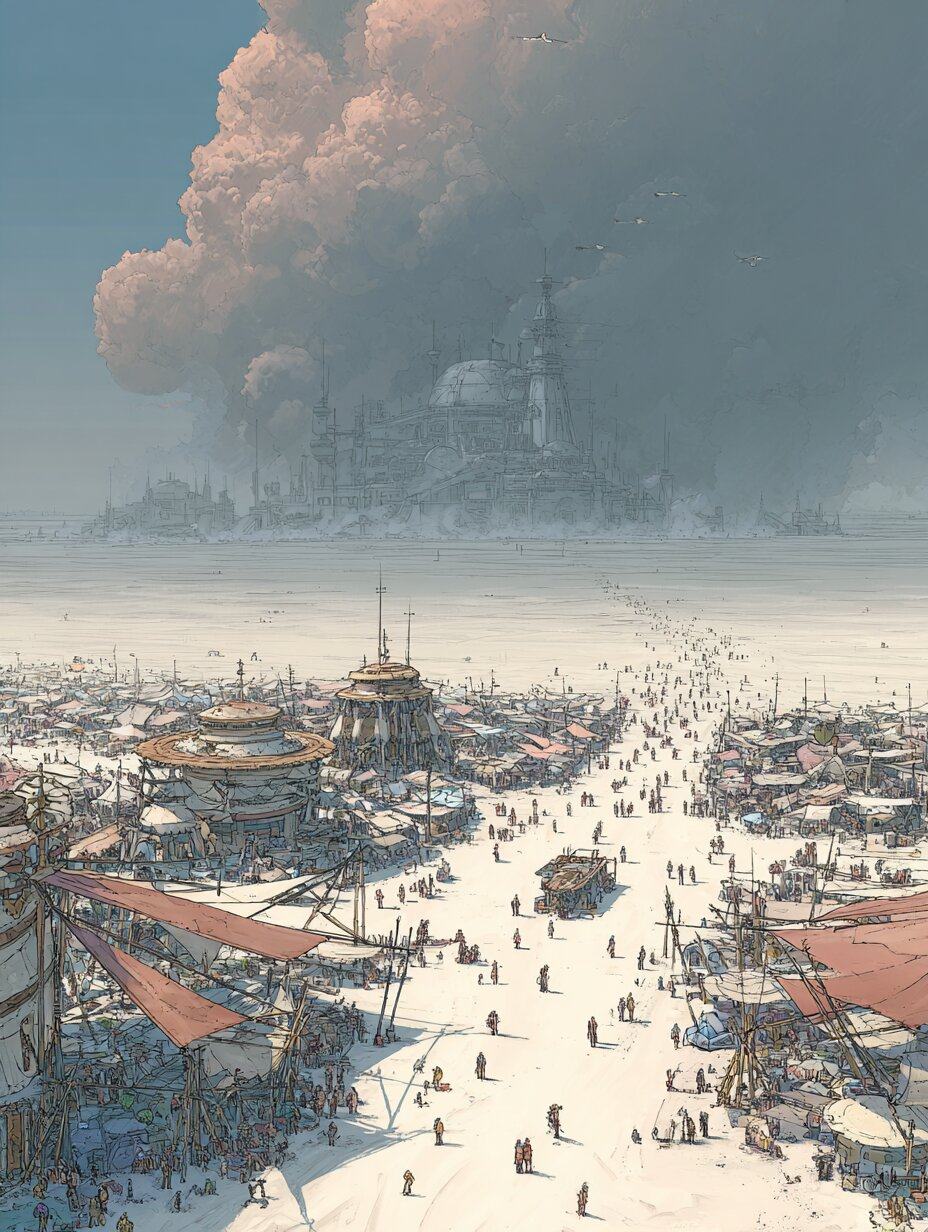
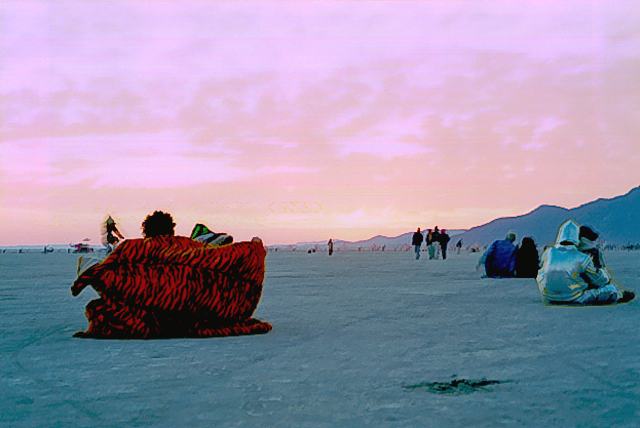
The first thing that hits you when you arrive at Burning Man is the dust.
The playa, the dry lakebed where the event happens, is covered in this fine alkaline powder. It gets everywhere. In your nose, your eyes, your hair, your clothes. It coats everything like moon dust.
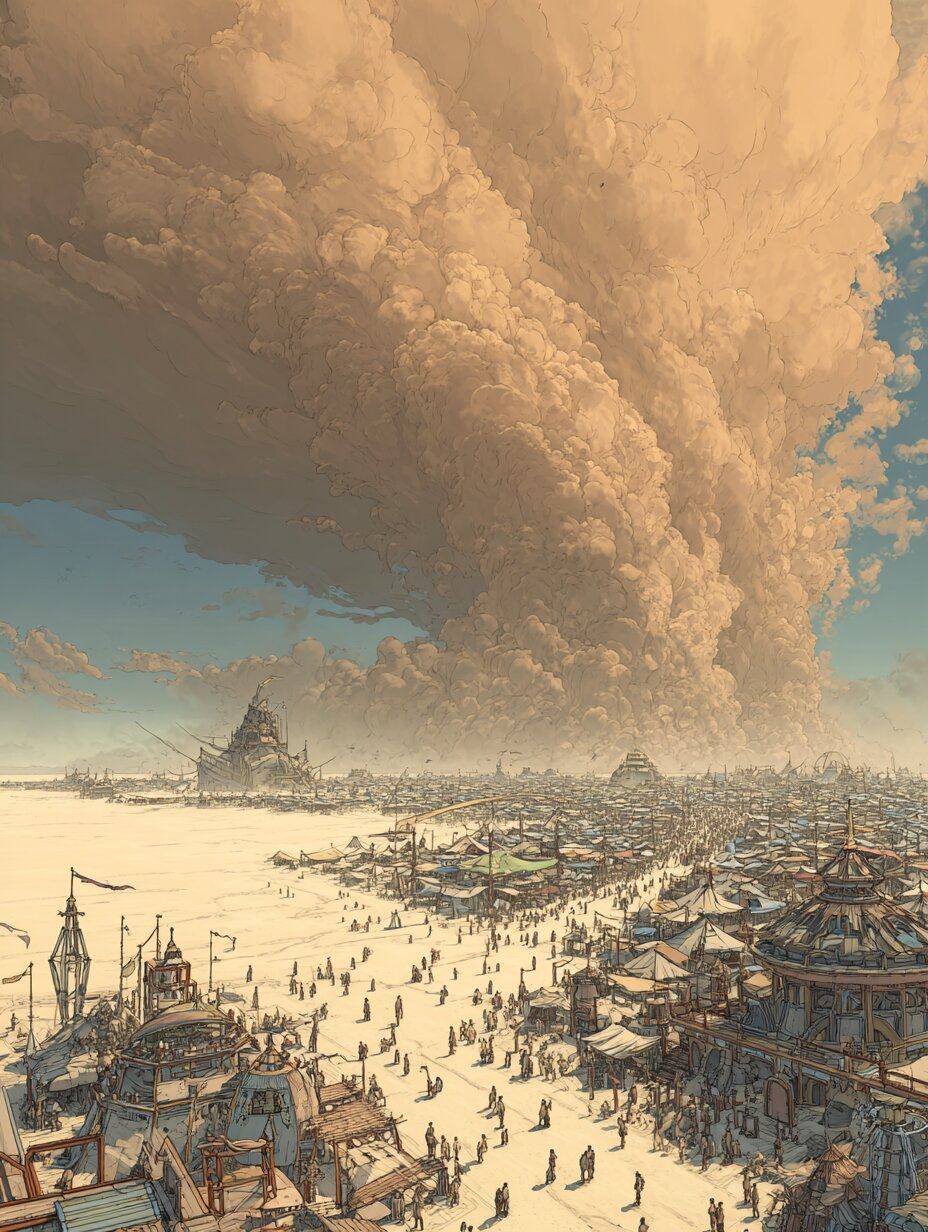
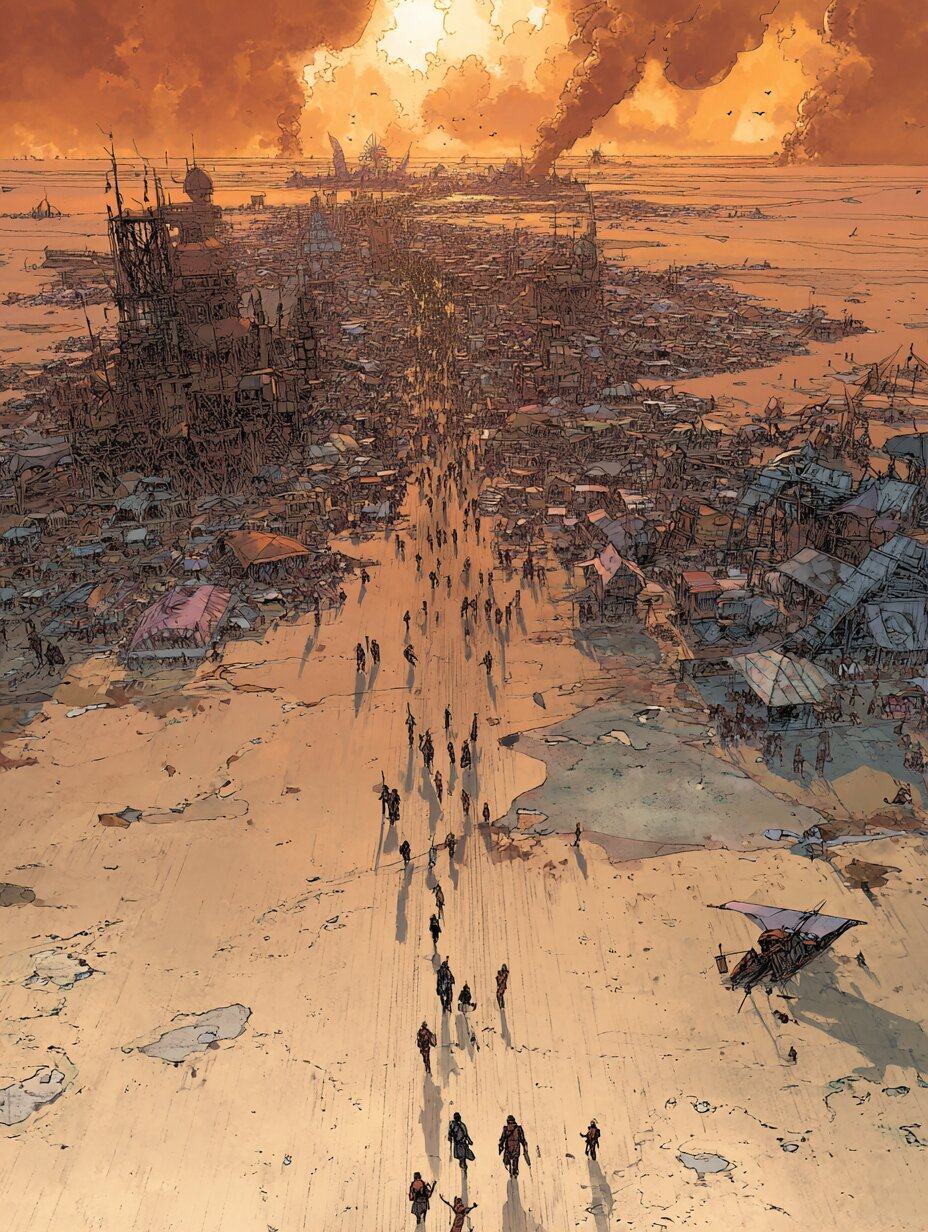
The second thing that hits you is the heat. This isn't pleasant desert warmth. This is biblical, apocalyptic heat. The kind that makes you understand why people hallucinate in deserts. Why prophets went into wilderness and came back with visions.
And the third thing, the thing that makes you forget about the dust and the heat and every other physical discomfort, is what they've built.
Imagine if someone gave artists a blank canvas the size of several square miles and unlimited creative freedom. No rules except: make something amazing, and leave no trace when you're done.
That's Burning Man.
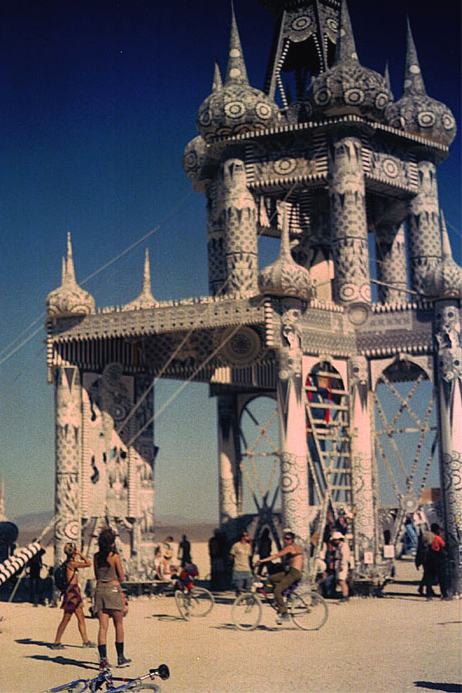
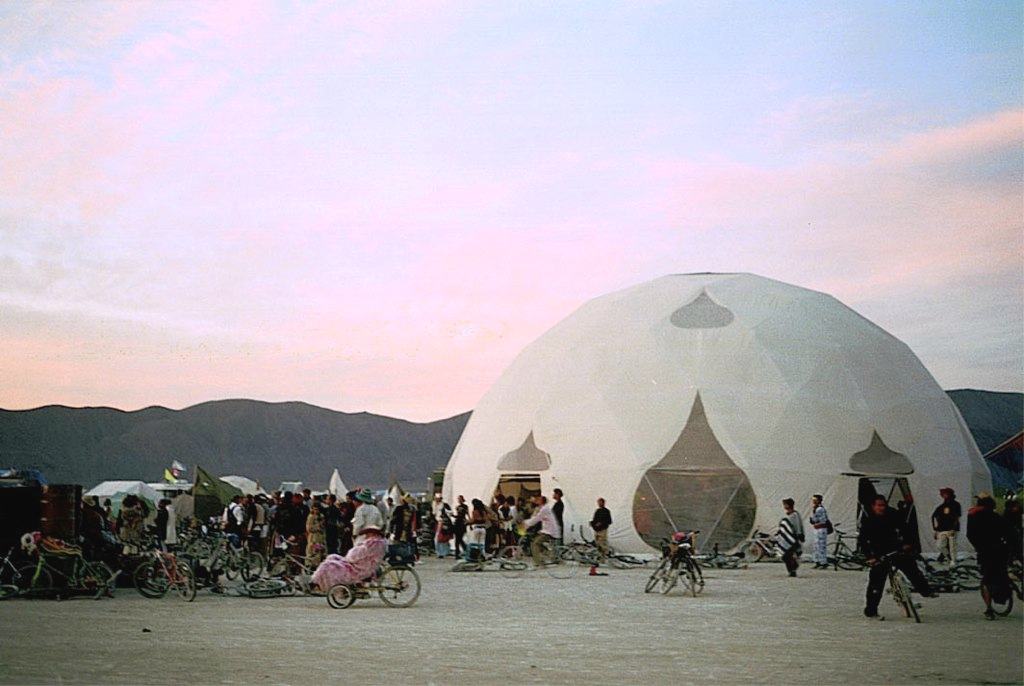
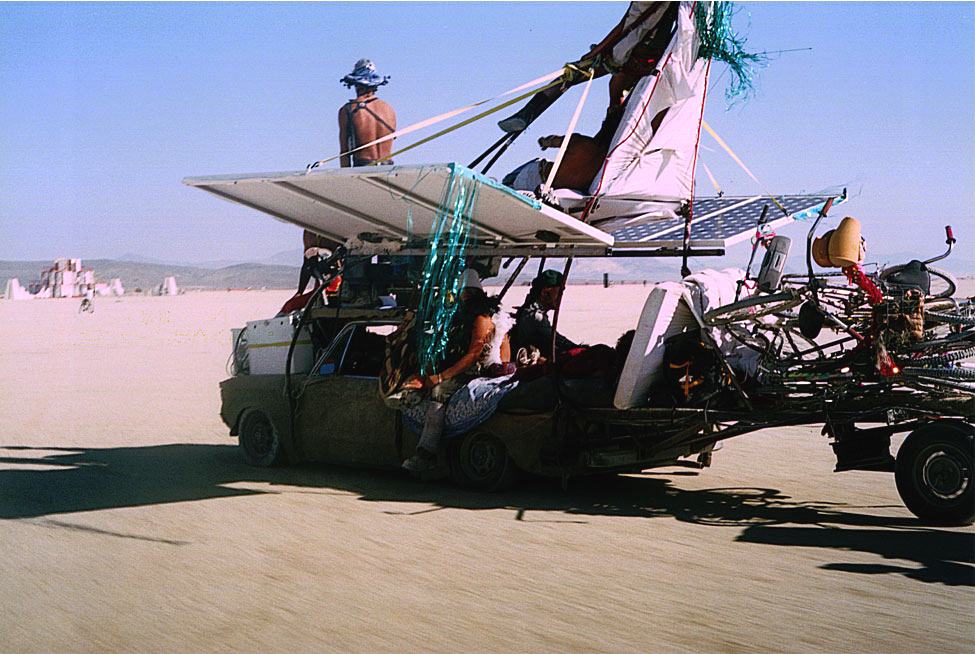
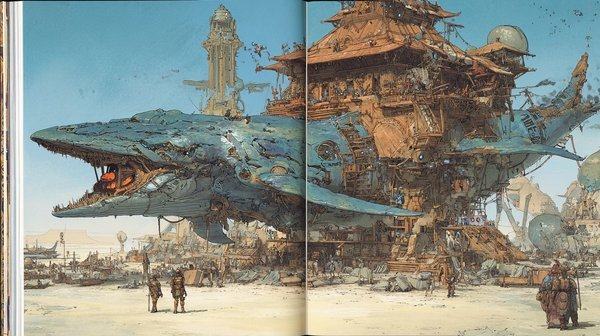
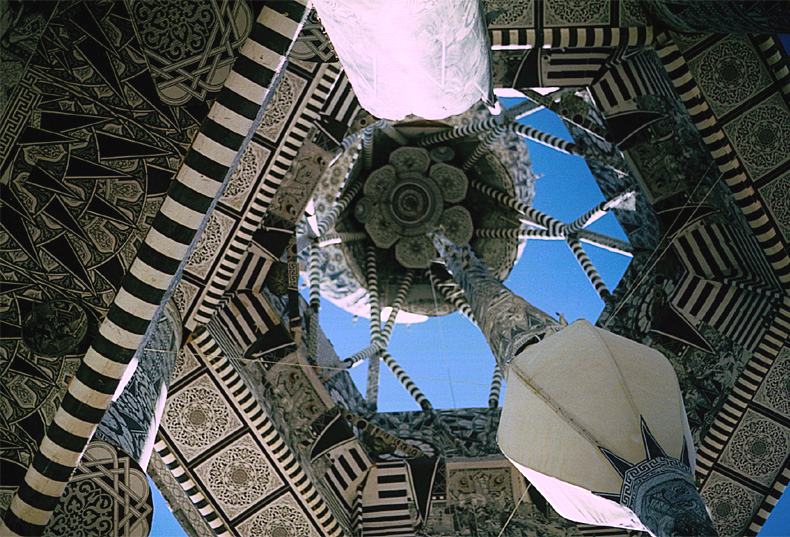
Art everywhere. Not gallery art. Not museum art. Art you can climb on, walk through, burn down. A forty-foot wooden temple. A fire-breathing mechanical whale. A full-scale pirate ship manned by people in elaborate costumes, sailing across the desert. Geodesic domes covered in LED lights. Sculptures that look like they're from another planet.
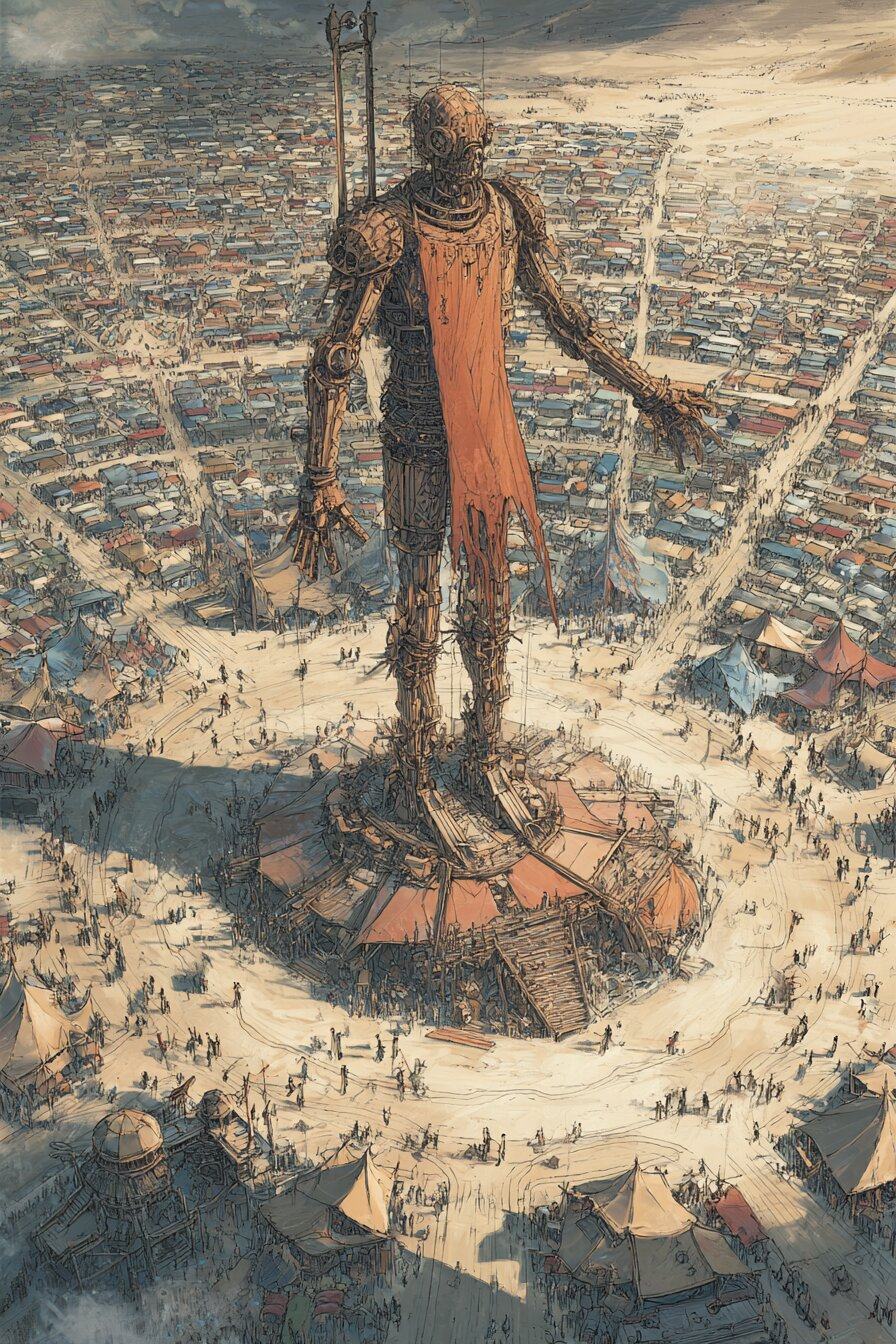
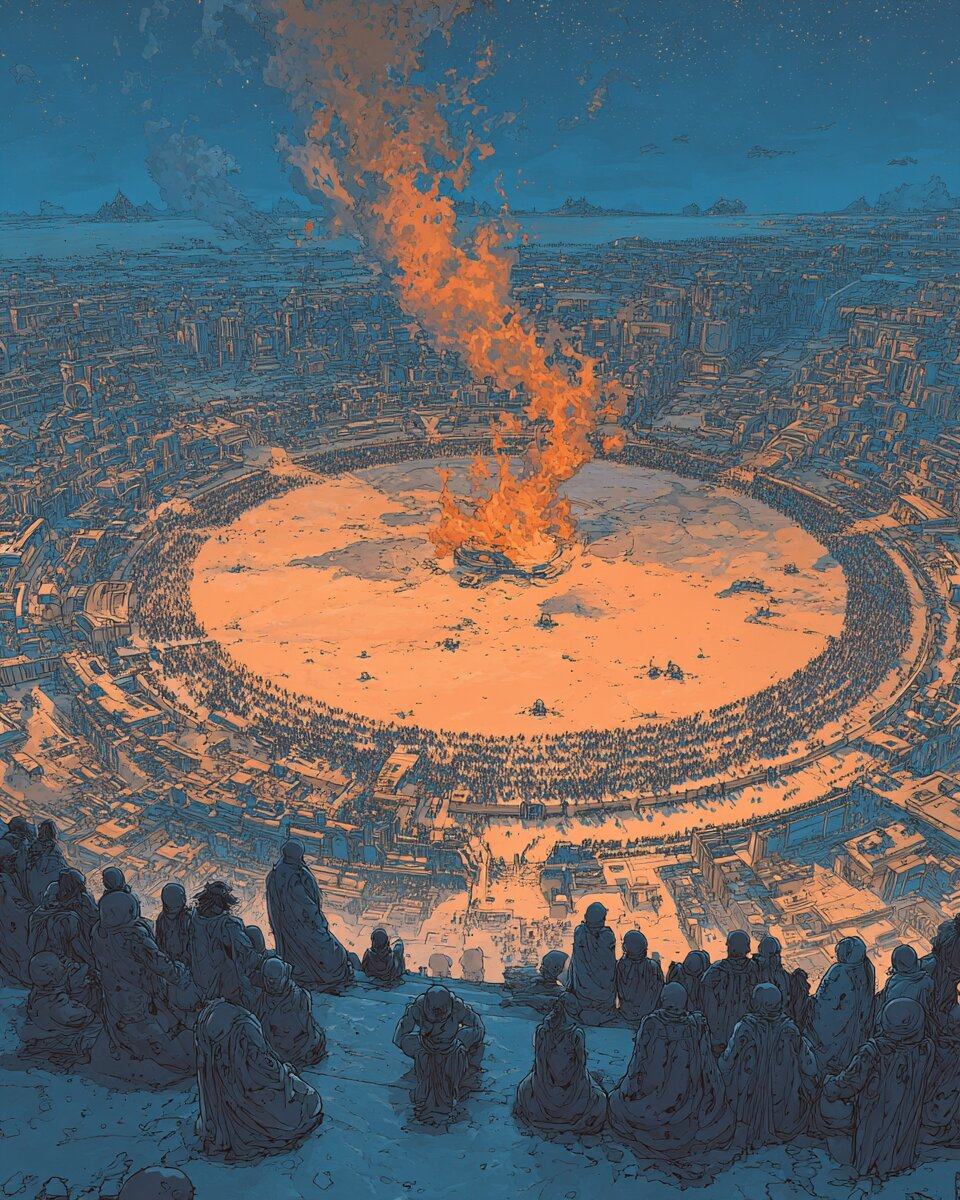
And in the center of everything: the Man. A wooden effigy fifty feet tall, standing on a platform, arms raised to the sky. On the last night of the festival, they burn him. Thirty-five thousand people gather in a circle and watch him go up in flames.
But that's the end. Let me tell you about the beginning.
My first night, I was wandering through the city, and it is a city, with streets laid out in a mandala pattern, different neighborhoods, different energy in each zone, when I heard the music.
Trance music.
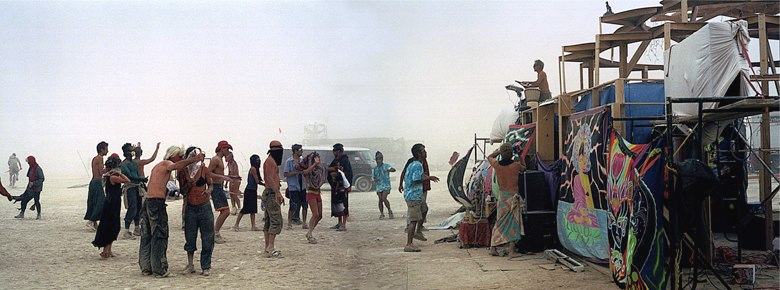
I followed the sound to a camp that had set up a full outdoor sound system. Not a DJ booth, a proper system, the kind you'd find at a festival. And the camp was giving away chai. Free chai. As much as you wanted.
“Gift economy,” someone explained when I asked why they weren't charging. “That's how Burning Man works. No money. You can't buy anything except ice. Everything else is gifted.”
I stood there, chai in hand, listening to trance echo across the desert, and felt something.
Home.
Not home like my parents' apartment in New York. Home like: this is my tribe. These are my people. This is the world I've been trying to find.
Sitting here with Akiko, I'm trying to convey the feeling of those seven days.
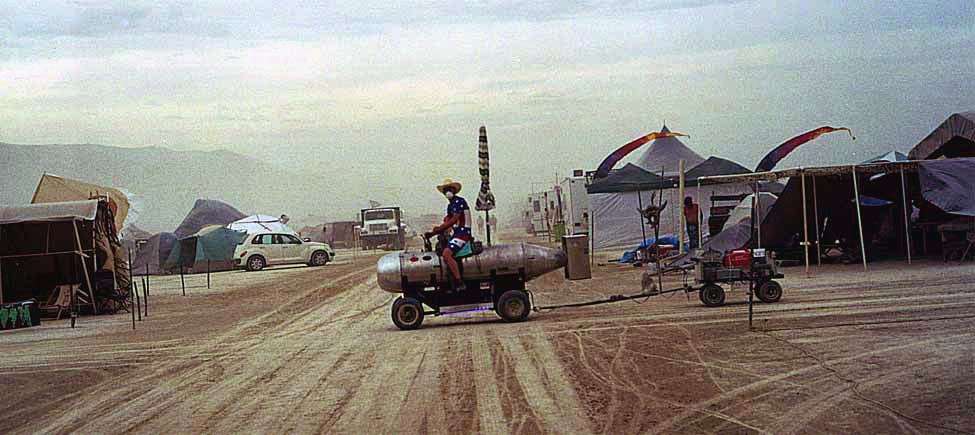
Every morning I'd wake up in my tent, which felt like a sauna by 8 AM because of the heat, and emerge into a city that looked like someone's fever dream.
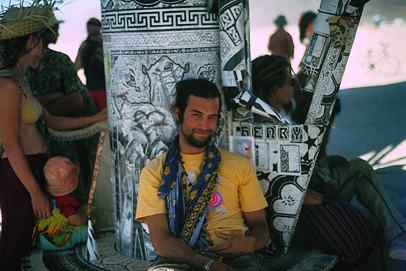
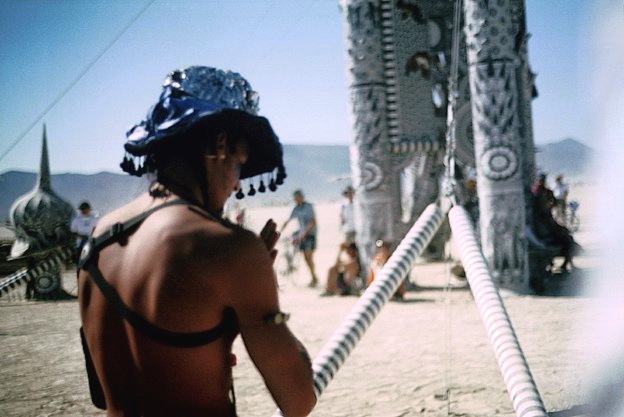
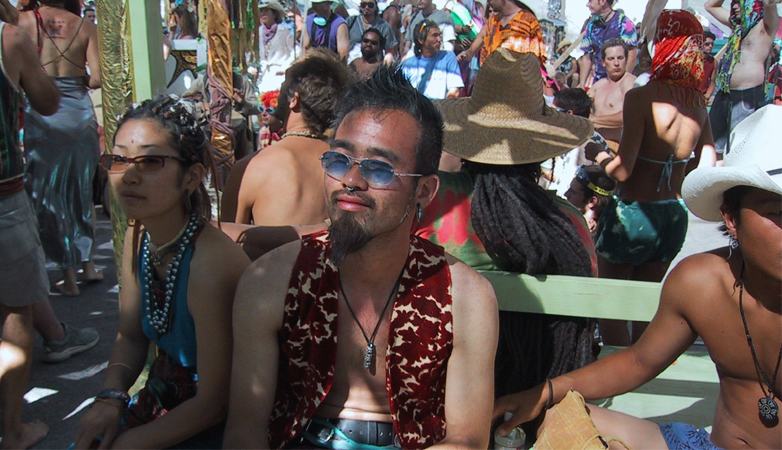
People in costumes. Not Halloween costumes, costume as art, as identity exploration, as play. Steampunk pirates. Robot mermaids. Victorian vampires. Naked except for body paint. Or wearing nothing but a tutu and a smile.
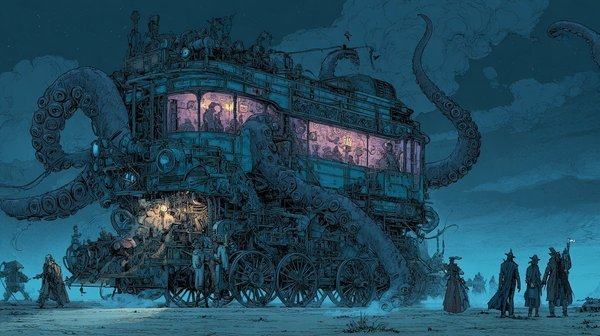
Art cars, vehicles converted into rolling sculptures, would cruise past. A glowing octopus. A giant high-heeled shoe. A double-decker bus transformed into a moving disco. Each one blasting different music, offering different experiences.
Floating vehicles, dripping in lights and glitter, house mobile bars in which Alice meets Mad Max's crew to have some mushroom brew. Spaceship mermaids riding glowing seahorses and dragging two dusty speakers at 3 miles/hr are followed by a parade of cartoonish freaks dancing to the trance that lingers in the ever so light sand particles that twirl in the air. In the background a fire-breathing whale chases the pirate ship manned by naked women and space cowboys, on their way to a sonic head-wash after having their poonani trimmed. Substances are abundant yet unnecessary. The energy field takes you to high places alone as this psychedelic montage celebrates its bardo nature. It's a surreal city in a profound landscape with every type of bizarre service, transaction, and communion.
The best part being the gift economy; no money transactions are allowed! (other than a pricey entrance fee, $250). All trade is made in barter form and everybody contributes in whatever way they can. Thousands of gift-giving pixies and elves are around to share trinkets and crafts, good luck charms, condoms, peyote and rum.
Someone would hand you a popsicle in the middle of the day. Someone else would offer to braid your hair. A camp would serve you a gourmet meal for free. Another would give you a foot massage.
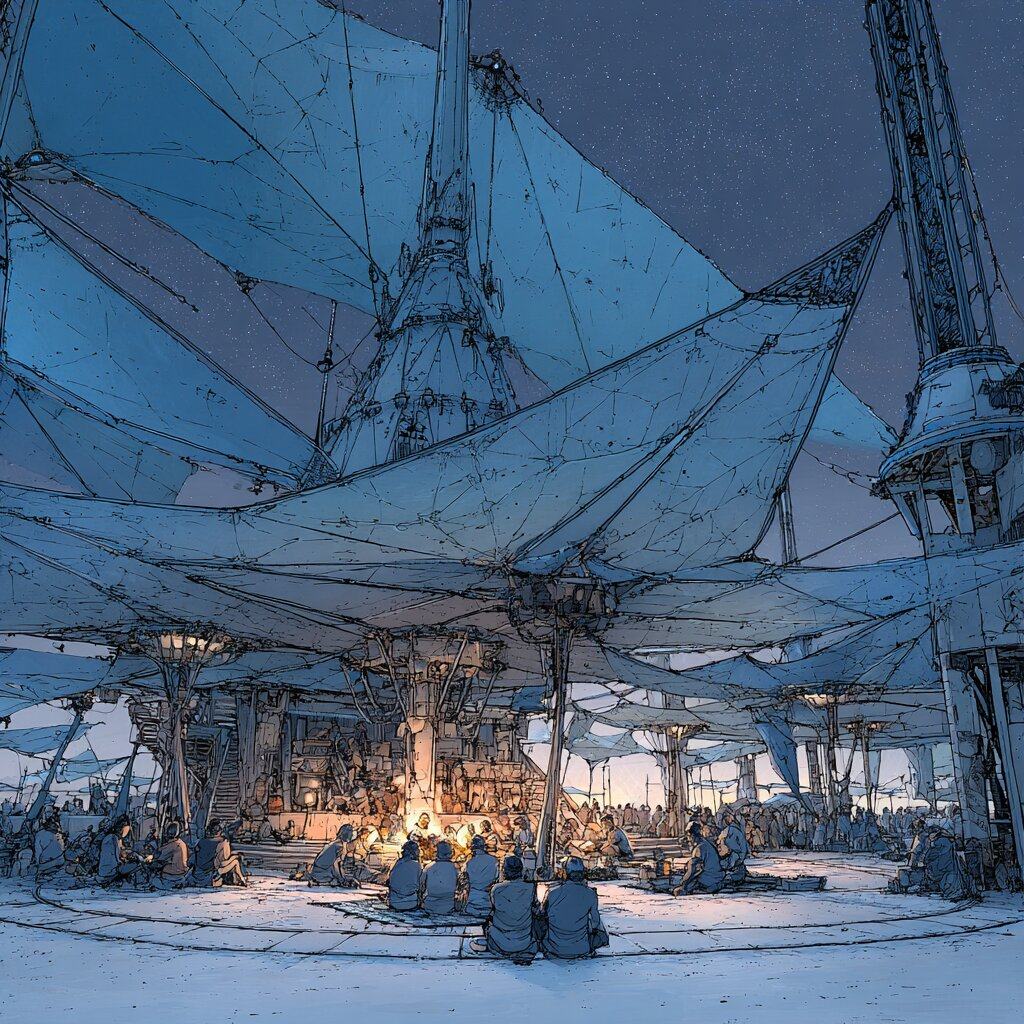
One afternoon, I wandered into the Temple.
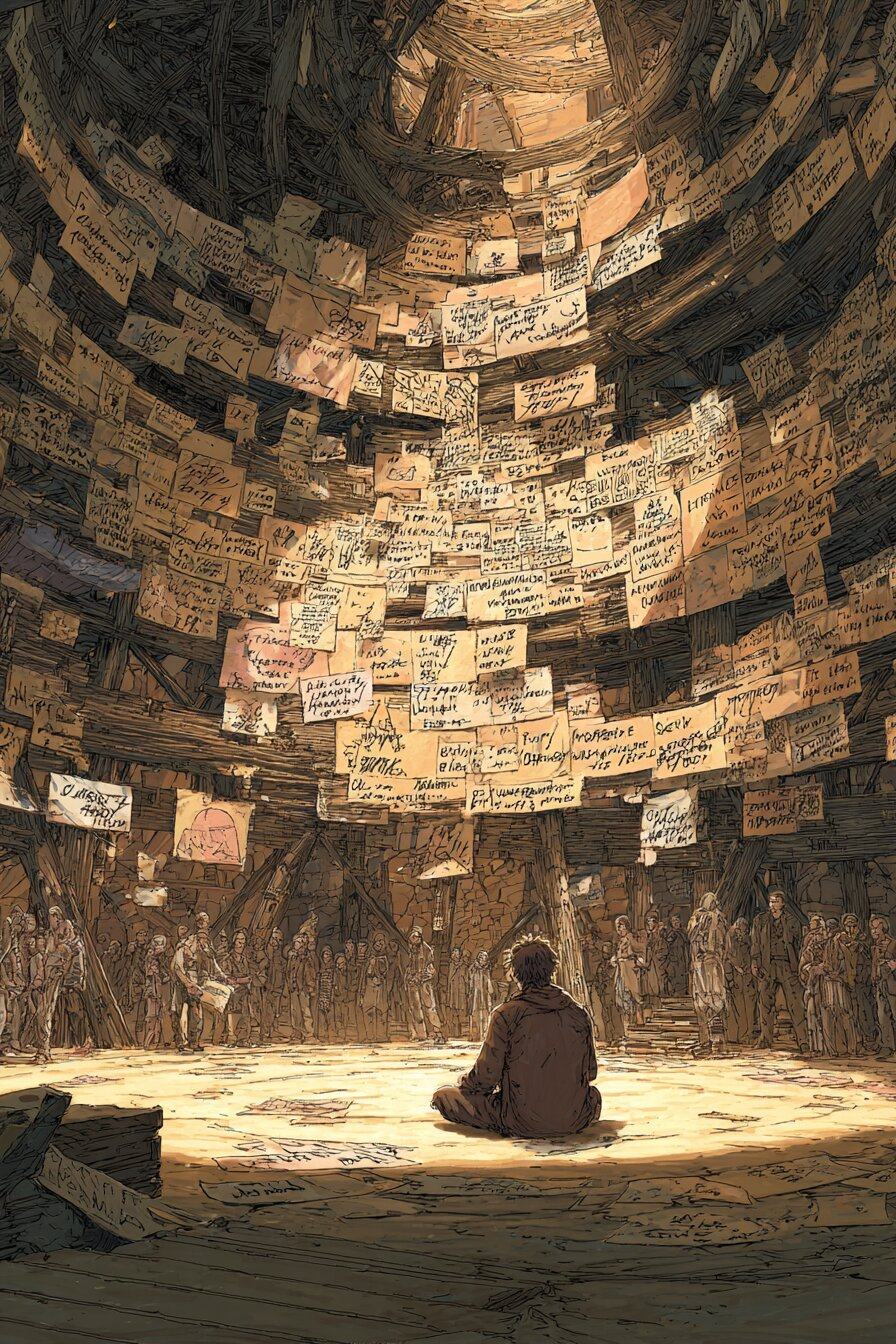
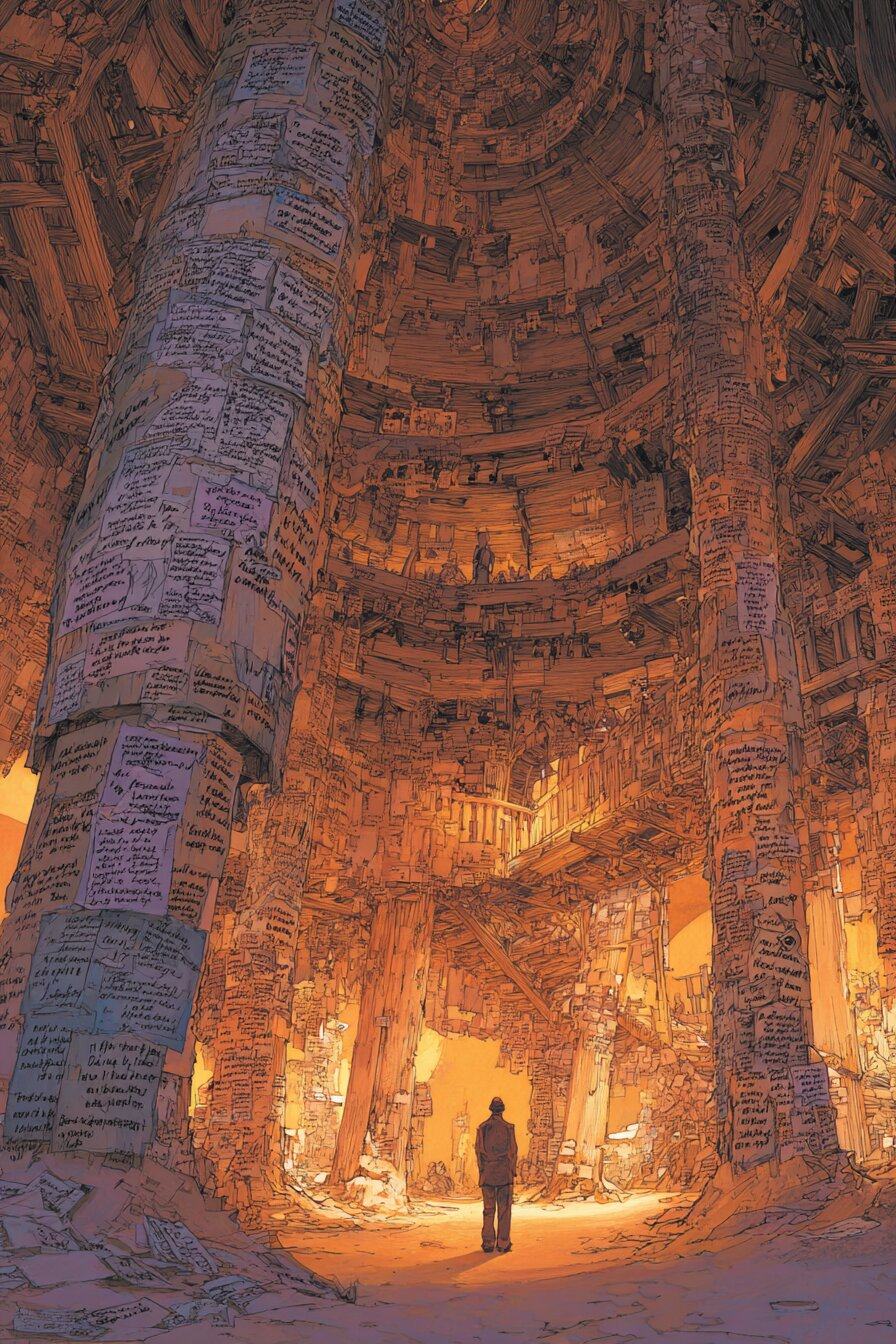
The Temple was different from the Man. Quieter. More sacred. Built as a space for grief and remembrance. People would write messages on the wooden walls: names of people who'd died, confessions, prayers, things they needed to let go of.
I stood there reading them. Thousands of messages. Layers and layers of human pain and loss and hope and love.
And I thought: This is real community. This is what happens when you create space for people to be vulnerable. To grieve together. To acknowledge the weight they're carrying.
On the last night of the festival, after they'd burned the Man in a massive fire ritual that drew the entire city into a circle, they burned the Temple.
It wasn't a party. It was ceremony. Thirty-five thousand people standing in silence, watching this beautiful structure go up in flames, carrying with it all the grief and prayers and confessions people had written on its walls.
Standing there in silence as the Temple burned, I could feel the city thinking as one organism, thirty-five thousand nervous systems entrained to the same flickering center. If the noosphere is real, I thought, this is one of its neurons firing.
I cried. I wasn't alone. Half the crowd was crying.
Because it was beautiful. And heartbreaking. And profound.
A collective letting go.
But Burning Man wasn't all deep spiritual moments. It was also gloriously, ridiculously hedonistic.
One night I ended up on an art car, a converted school bus covered in lights and lasers, with a hundred people dancing on top of it as it crawled across the playa at three miles an hour.
The DJ was playing psychedelic trance. The same music I'd heard in Tulum, in Guatemala. But here it felt different. More integrated. Like it was the soundtrack to something larger than a party.
We danced for hours. As the sun came up, someone started passing around a joint. Then someone else had mushrooms. Then someone had a bottle of tequila.
And normally, in the default world, that would be sketchy. Strangers sharing drugs and alcohol would feel dangerous or irresponsible.
But here it felt natural. Because the entire ethos of Burning Man was: we're all responsible for ourselves. We're all adults. We're all here to explore and play and push boundaries. And we trust each other to do it consciously.
Radical self-reliance. Radical self-expression. Radical inclusion.
Those were the principles.
And they worked.
Akiko stops typing.
“The costumes,” she says. “The tutus, the body paint, the robot mermaids. Were people hiding?”
The opposite.
A mask you choose is not a mask. Wear it for five days in that heat, on that bus, and it starts to talk. What comes out is not the costume. It is whatever the costume was protecting.
That is the oldest ritual there is, and I tried to give her the version I had worked out on dancefloors.
The music creates this space. The dance floor itself creates this temporary autonomous zone, as Hakim Bey would say, where everything goes.
“So what is the true self?” she asks. “The archetype.”
Each person is a color, part of a spectrum of colors. You may be blue, someone else may be too, but you are a unique shade of blue. You are blue, say, 35.2. The other person is blue 39.1.
In your lifetime, while you expand your consciousness and you deepen your understanding of yourself, you will start to uncover the decimal points of your unique shade of blue. From 35.2 to 35.2385.
That is essentially what every artist, philosopher, writer, thinker, musician is doing when they are fine-tuning their sound, or understanding what their meaning of blue is.
You fine-tune your archetype.
Stereotypes are fallen archetypes. They are watered down and superficial versions. They define classes, but rather than dealing with the transcendental universal truths that transcend time and space they are subject to changing with period and time and are often subject to how culture is processing the previous stories that had been told and regurgitated.
Now take one color and put it on a stage.
Not a dancefloor. A stage, a spotlight, a microphone, and every eye in the room pointed the same way.
That is a different machine. To explain what the desert was I had to explain that machine first, and the machine begins with Elvis.
Think of us as little beings, and our consciousness is a glow that comes off of our head very much like a halo. When we pay attention, that halo turns into a flashlight beam, a laser beam that gets concentrated on whatever we're paying attention to. When we're in a movie theater or in the theater itself, the screen or the actors' faces are places where our collective gaze and attention is concentrated, synchronized. We are all downloading a story in real time, coordinating our feelings, being programmed with meaning.
Elvis on a stage, the screaming, the feedback loop.
That is a star. One node, and everyone else in orbit around it.
Black Rock City had no node. No headliner. No face on a poster. Thirty-five thousand bubbles of water, each with its own light inside, and no spotlight to point them all at.
A society of stars, if the word still means anything once everyone is one.
That was the experiment.
It is thus crucial that you become an active participant of this city and not just a tourist/spectator. All this happens in spontaneous dance; there is no main attraction other than the people who are in it. Everyone is there to play.
One afternoon, mid-week, I met a woman named Laura. She was part of the infrastructure team, the people who actually built the city. Set up the roads, the porta-potties, the emergency services.
We were sitting in the shade of her camp, drinking warm water, and I asked her about the design philosophy.
“Why so few rules?” I said. “Thirty-five thousand people in the desert, drugs everywhere, fire everywhere, art cars driving around, how does this not turn into chaos?”
She smiled. “That's exactly the question the county asks us every year. They want us to add more fencing, more checkpoints, more security, more rules. And we have to constantly push back.”
“Why?”
“Because more rules don't make people safer,” she said. “They make people stupider.”
I laughed, but she wasn't joking.
Listening to Laura, I realized she wasn't saying no rules. Burning Man had rules, fire guidelines, speed limits for art cars, rangers who intervened when things got dangerous. It was more like: just enough structure to keep people from dying, and no more. The rest was left to culture, to norms, to the quiet pressure of knowing nobody was coming to save you.
“Think about it,” Laura continued. “When you add a fence, what are you really saying? You're saying: ‘You can't be trusted to make good decisions. We need to physically prevent you from doing something stupid.’ And what happens when you treat people like children who can't be trusted?”
“They act like children?”
“Exactly. They stop taking personal responsibility. They stop being alert. They assume someone else has thought through all the risks, so they don't have to.”
She pulled out a notebook, started sketching.
“I used to work commercial festivals. Big ones. EDC, Coachella. And every year, the insurance companies would demand more safety measures. More barriers, more checkpoints, more security. And every year, the medical incidents would stay the same or get worse.”
“Why?”
“Because you're fighting human nature. If someone wants to climb a fence, they're going to climb it. And now instead of just walking somewhere, they're climbing over a six-foot barrier, drunk, at night, and getting hurt in the process.”
She flipped the notebook around to show me. She'd drawn a simple diagram, an intersection with too many stop signs.
“Imagine a small town,” she said. “Traffic increases, so they add a stop sign. Traffic increases more, so they add another. And another. And pretty soon you have this intersection with so many signs and signals that nobody knows who has right of way anymore. The system designed to simplify has created more complexity.”
I thought about this. About every airport security line I'd ever stood in. Every form I'd had to fill out in triplicate. Every pointless regulation that existed not to solve a problem, but to cover someone's ass.
“There's a study,” Laura said, “from a town in Holland. They removed all the traffic signals. All of them. Just... gone. And you know what happened?”
“Chaos?”
“Fewer accidents. Significantly fewer. Because when you don't have a light telling you when it's safe to go, you have to actually pay attention. You have to make eye contact with other drivers. You have to think.”
She leaned back, took a sip of water.
“That's what Burning Man does. We create the minimal infrastructure needed for people to not die, water, medical, emergency services, and then we get out of the way. We trust people to be adults. To look after each other. To make good decisions, or at least learn from bad ones.”
“And it works?”
“Better than any commercial festival I've ever worked. Not perfect. But better. Because people feel responsible. They know there's no one coming to save them if they fuck up. So they're more careful. More aware. More present.”
I thought about the journey. About how the places with the least infrastructure, the beach towns in Mexico, the jungle lodges in Peru, the villages in Guatemala, were the places where I'd felt most alive. Most engaged. Most responsible for my own experience.
“You know what the worst injury we had last year was?” Laura asked.
I shook my head.
“A guy ripped his scrotum trying to climb over a fence.”
I winced. “Jesus.”
“Yeah. And the fence wasn't there to keep people safe. It was there because the county required it. Because on paper, fences make things safer. In practice, all it did was create an obstacle that someone inevitably tried to climb, drunk, at three AM.”
She closed the notebook.
“There's this ancient Greek god. Hephaestus. God of craftsmanship, tool-making, metallurgy. You know what his defining characteristic was?”
“What?”
“He was a cripple. A hunchback. The price of technical mastery was physical deformity. The tools shaped the toolmaker.”
I understood what she was getting at.
“The more we design systems to eliminate friction,” Laura said, “the softer we become. The less capable. I've traveled all over the world. India, Cuba, Nigeria, Burma. You know what I noticed in every developing country?”
“What?”
“The people are incredibly resourceful. They can fix anything with nothing. They're alert, ingenious, resilient. And then I come back to America and see people who can barely change a light bulb. Who panic if their phone dies. Who've outsourced every basic skill to a service or an app.”
She gestured at the playa around us.
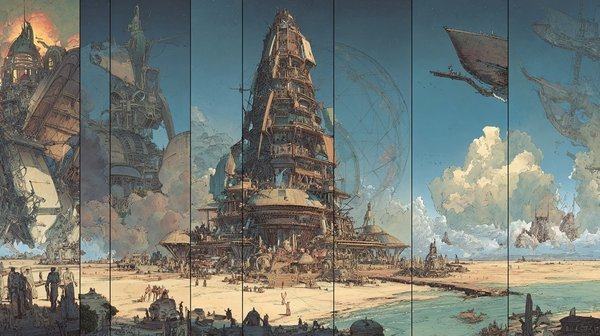
“That's why this place matters. Because for one week, people have to figure shit out. Your tent collapses in a dust storm? Fix it. You run out of water? Ask your neighbors, or walk to the nearest water station. Your bike breaks? Figure it out or walk.”
“Friction sharpens us,” I said, remembering something I'd read once.
“Exactly. Friction defines us. We're humans because we fought gravity, stood on two legs, made tools with our hands. Every comfort we design, every convenience we engineer, we're trading a piece of our capability. Our humanity.”
She pulled out another sketch, a drawer.
“Imagine two knife drawers,” she said. “One is velvet-lined. Soft. Protects the knives from any contact. Over time, what happens to the blades?”
“They get dull.”
“Right. Now imagine a drawer designed so that every time you put a knife in or take it out, it passes over a sharpening stone. What happens?”
“The blades stay sharp.”
“That's good design,” Laura said. “Not design that eliminates friction, but design that uses friction intentionally. Design that sharpens us instead of dulling us.”
I thought about this for a long time after she left.
About how the modern world is the velvet drawer. Everything smooth, everything easy, everything designed to minimize discomfort. And we're getting duller as a result.
Burning Man was the knife drawer that sharpened. Harsh. Uncomfortable. Demanding. And precisely because of that, it woke people up.
That conversation with Laura changed how I saw everything at Burning Man.
Sitting here trying to explain this to Akiko, I keep coming back to one word: temporary.
Burning Man is a temporary city. A temporary utopia. A proof-of-concept that lasts exactly one week before everyone packs up and goes back to their regular lives.
And that temporariness is crucial. It's not trying to be a permanent alternative society. It's not trying to replace the default world. It's creating a space where people can experience what's possible. Where they can try on different identities, different ways of being, different social structures.
And then they take that back with them.
That's the whole point.
Burning Man is a seed. You plant it in the desert for one week, and then people carry those seeds home and plant them wherever they live.
On the last day, they have a ceremony called leave no trace.
Thirty-five thousand people spend hours combing the playa, picking up every piece of trash, every scrap of debris. The goal is to return the desert to exactly how it was before they arrived.
No permanent structures. No lasting impact. Just the temporary magic of a city that existed for one week and then vanished.
I spent my last morning on my hands and knees, picking up tiny pieces of glitter and cigarette butts, thinking about this.
About how the beauty was in the impermanence. How creating something amazing and then letting it go was more powerful than trying to make it last forever.
About how that was true for Burning Man, but also true for everything. For relationships. For moments. For life itself.
You create beauty. You participate fully. And then you let it go.
The more one embraces the traditions of this city, the stronger its seductive magical powers become. And as the fire burns the art to the ground, we leave no trace, and stare with awe at the flames that guide our meditative state, letting us scream with ecstasy and cleaning our souls. That is where we shall keep the fire till this living collage of extremities re-emerges next year; same place another time, in a parallel universe.
May the creative force be with you…
Exhausted, sunburned, covered in dust, I felt different.
Akiko stops typing, stretches.
“So you're saying Burning Man is like... a reset button for society?”
“Kind of,” I say. “Or maybe more like a prototype. A working model of what could exist if we organized differently. If we valued creativity over productivity. If we trusted each other instead of fearing each other.”
“But it only lasts a week.”
“Yeah. But that's enough. Because once you've seen it, once you've lived in a city with no money, where people gift freely, where art is everywhere and everyone participates, you can't unsee it. It changes your baseline for what's possible.”
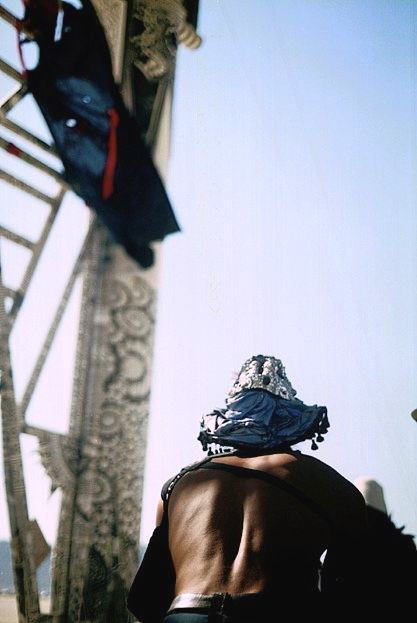
“And then you go back to Babylon.”
“And then you go back to Babylon,” I agree. “But you're different. You carry the temple with you. The fire. The reminder that another world isn't just possible, it's already happening. You just have to know where to look.”
Outside the window, New York is the opposite of Burning Man. Permanent structures. Money everywhere. People rushing, disconnected, trapped in routines.
But I know now, after the journey, after Burning Man, after these months of trying to integrate it all, that the same principles apply everywhere.
You can create Black Rock City anywhere. Even in Babylon. Even in your own apartment, your own neighborhood, your own life.
You just have to choose it.
Over and over.
In each moment.
Akiko closes her laptop.
“Next session?” she asks.
Next session.
She leaves. I sit in the quiet apartment, watching the sun set.
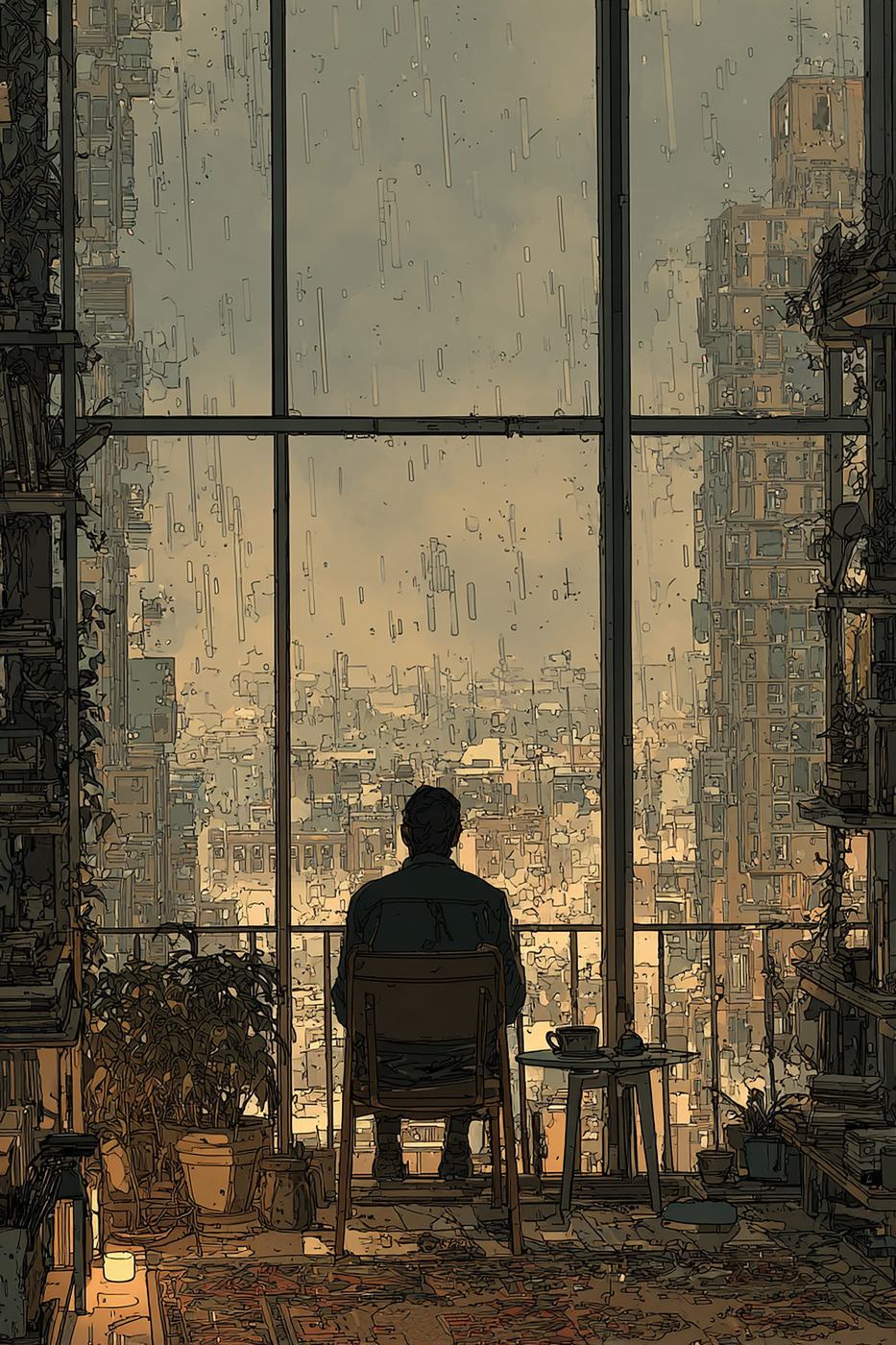
BATTLEFIELD AND DANCEFLOOR
Another night, after Akiko leaves, I'm sitting by the window thinking about Burning Man. About those seven days in the desert. About the thirty-five thousand people who gathered to create something temporary and beautiful.
And suddenly I remember something Yaya Vera, my grandmother, told me when I was thirteen: the story of the two tribes in the valley, five days and five nights. I tell it whole after September 11, where it belongs.
That feedback loop from the energy and the crowd amplifies that energy and essentially that is why the parties are so important, because they counteract the negative energy released in the world during war. In many ways, participating in these rituals is not a frivolous act but actually an important rite of passage and pilgrimage that is crucial in creating the balance between negative and positive, the zero and the one.
It struck me that this was the same pattern I'd been seeing everywhere: the poles weren't enemies. War and festival, fear and joy, Babylon and Black Rock City, they were opposite charges in the same circuit. The current only flowed because both ends existed.
The ancient warriors found their gods on the battlefield.
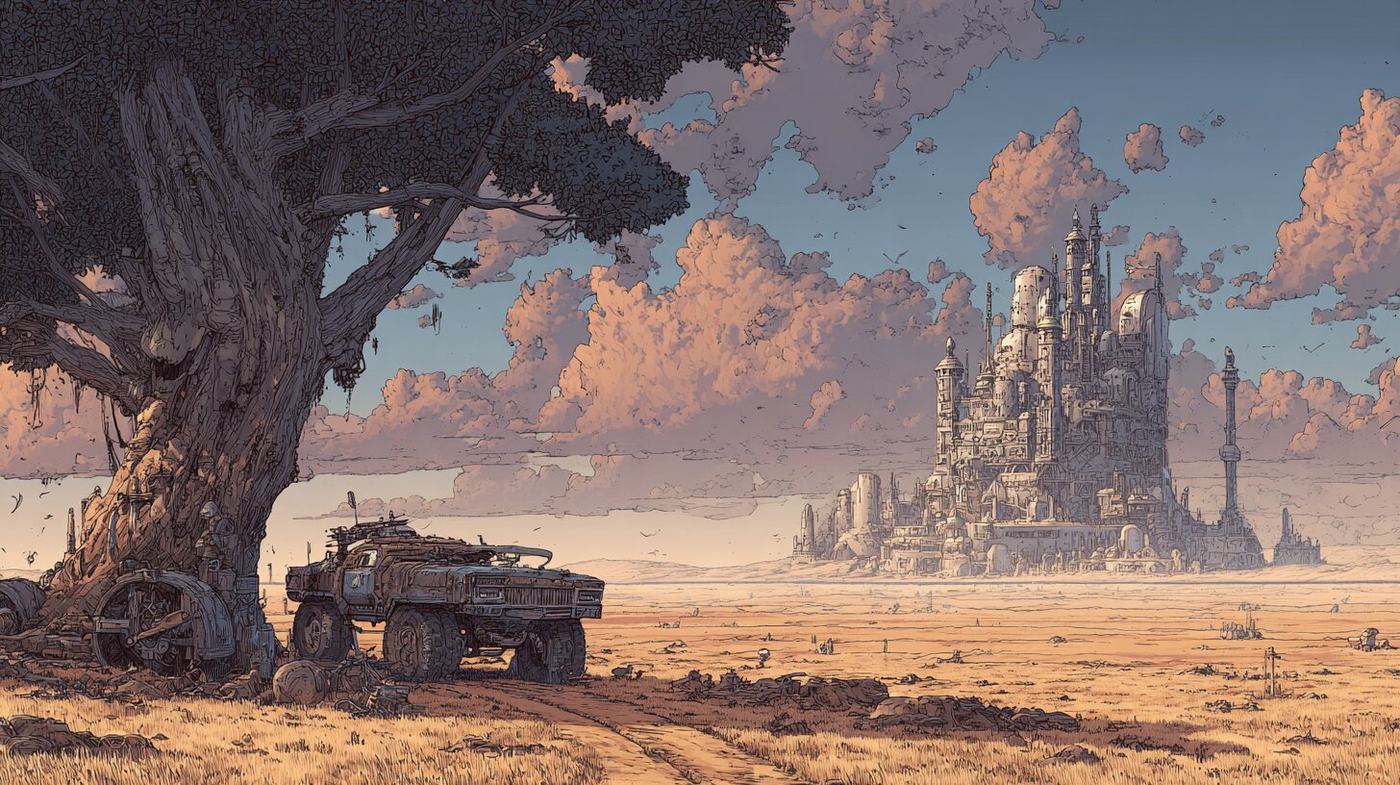
We found ours on the dancefloor.
That's the practice.
That's the path.
That's the dance.
Birth of a Star
Interlude
What we say and how we move and how we ultimately express that within us permeates the air, which let’s not forget is a medium in its own right. Our voice, our body motion, move the air molecules around us and send out our signature in the form of a vibration. People who we admire, artists, dancers, athletes, actors, singers, are able to transmit what they have inside of them in a clear, strong and well-identified signal.
At some point in our modern history, we managed to create machines that, in an analogical way, amplify that vibration: amplifiers, microphones, speakers, electric guitars. This gave people the ability to industrially magnify that which they have inside of them.
So, it should not come as a surprise that when Elvis showed up on the stage and in his very charismatic way, shook his hips and threw his jaw and spanked his guitar, that people would lose their minds. At that time period, the feelings that he embodied truthfully were so ahead of his time yet were hungered for by a repressed generation in the shadows of the Cold War and parents who had fought in the Second World War. On the stage, Elvis represented the future: he embodied it, and beamed it out of the speakers in an amplified way. That energy blanketed the audience who, in return, screaming, sent that amplified signal right back to him, in a feedback loop form, which made Elvis feel more confident and sing and dance with greater expression, which excited the audience further until the feedback loop of energy became so strong that the focal point (Elvis) became a star. Literally, no longer orbiting around but becoming a point of reference: in a sense, something to orbit around.
This phenomenon was so radical at the time that the few channels, TV, Radio, Magazines and Newspapers, covered these newly born “Gods” trying to decipher their ever-expanding influence and power over popular culture. Through the snippets that the media was able to capture, the public eye slowly began to shape the narratives of these new “Gods.” Gods might sound like an overstatement but if you really look at it in the mythological sense, each artist represents a different crowd, a different demographic. The feedback loops graduate from the confined environment of a specific performance or movie or experience into the greater world, through media and interviews and appearances, reactions and articles. Each time you send your narrative out into the world you are painting the portrait of how your avatar is collectively received.
In the beginning you have massive Gods and fewer of them, and then you have more and more channels and more Gods, yet each is less influential. Each represents a different part of the tribe and different demographics. You start to see funny narratives unfold within the constellation of celebrities / Gods which resemble archetypal stories from ancient myths and also universal truths about humans.
Each musician is the crystallization of how that group of people wishes they were and just as we have Sports Illustrated Swimsuit Edition, Playboy, Penthouse and XXX porn, similarly you have Bon Jovi, Guns N' Roses, Metallica and Megadeth. And as we move through time, these Gods handle their public image in different ways. Some of them can’t handle how misinterpreted they might have been in the eyes of the public or are unable to handle moments of shame that slip out without their control. Examples of such trainwrecks are: Michael Jackson, Marilyn Monroe, Janis Joplin, Jim Morrison, Kurt Cobain. And yet there are others, who in very graceful ways, have been able to diffuse or even manipulate negative situations to work out in their favor. Examples of this are: The Kardashians, Donald Trump, Paris Hilton and other reality stars that have no reason to be on TV, yet are. As we move through time, and the channels and feedback loops of that attention increase, we start to generate many more stars.
When we arrive at today and we each have Instagram, Twitter, Facebook, Snapchat, Tumblr, etc. and we can create our own feedback loops it is important to note how we seek that attention. How do we want to bubble up from the individual scale to the collective and how can we retain control of our own narrative so that we do not become victims of our own vanity. How does a girl who is shy and posts a semi-sexy picture of herself and gets a lot of positive responses that encourage her to behave in a more risqué way, learn how to seek attention by sharing more meaningful parts of herself rather than purely hitting the biological, instinctual reflex button? We can design and construct and breathe life into our avatars so as to become them, eventually. Or, we can carelessly and thoughtlessly let narrative be formed through ego, fear and shame, only to be enslaved by it at the end.